





Introduction
In Grade 5, solve real-world problems that involve plotting and interpreting points on the coordinate plane. They connect graphing to patterns, measurement, and other mathematical concepts studied throughout the year.
Solving Problems on the Coordinate Plane matters because it blends concept understanding, visual reasoning, and accurate practice. When students can explain the math, model it, and apply it in context, they build confidence that carries into quizzes, classwork, and bigger Grade 5 problem solving.
What Is Solving Problems on the Coordinate Plane?
Solving Problems on the Coordinate Plane is the Grade 5 skill of students solve real-world problems that involve plotting and interpreting points on the coordinate plane. They connect graphing to patterns, measurement, and other mathematical concepts studied throughout the year.
Strong understanding comes from naming what the numbers, shapes, units, or data values represent, then showing the idea with a model or clear steps before solving.
Understanding Solving Problems on the Coordinate Plane
The key to this topic is understanding the structure behind the work, not just following a rule. Students should be able to talk through what is happening, point to a model, and explain why the answer makes sense.
- Read the horizontal value first and the vertical value second.
- Match the point or pattern to a real situation instead of plotting blindly.
- Use labels and ordered pairs carefully so the graph tells a clear story.
- Use the topic language from class discussions: Students solve real-world problems that involve plotting and interpreting points on the coordinate plane. They connect graphing to patterns, measurement, and other mathematical concepts studied throughout the year.
Visual Models
Visual Model 1
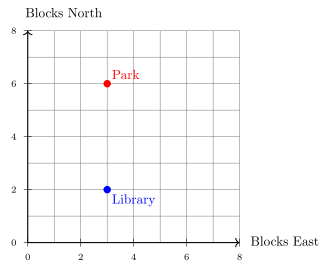
Question: A map uses a coordinate grid where each unit represents 1 block. The library is at \((3, 2)\) and the park is at \((3, 6)\). How many blocks apart are they?
- A. 2 blocks
- B. 3 blocks
- C. 4 blocks
- D. 6 blocks
How the model helps: Both points have the same x-coordinate (3), so they are on a vertical line. The distance is \(6 - 2 = 4\) blocks north.
Visual Model 2
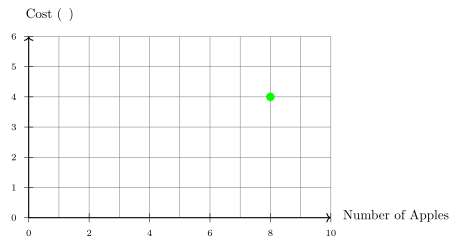
Question: A grocery store tracks the cost of apples. The graph shows the relationship between the number of apples bought and the total cost. What does the point \((8, 4)\) mean on this graph?
- A. 4 apples cost $8
- B. 8 apples cost $4
- C. 12 apples cost $8
- $4 buys 12 apples
How the model helps: The x-coordinate is the number of apples (8), and the y-coordinate is the cost in dollars (4). So 8 apples cost $4.
Step-by-Step Examples
Example 1
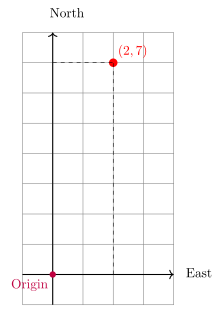
Question: Point \((2, 7)\) is plotted on a coordinate plane. Which direction is this point from the origin?
- A. 2 units west and 7 units up
- B. 7 units east and 2 units up
- C. 2 units up and 7 units east
- D. 2 units east and 7 units up
- The x-coordinate (2) means 2 units east, and the y-coordinate (7) means 7 units north (up) from the origin.
Answer: 2 units east and 7 units up
Example 2
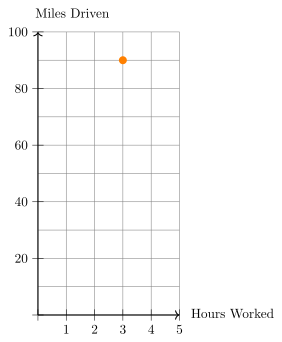
Question: A restaurant tracks miles traveled by delivery drivers. This graph shows the relationship between hours worked and miles driven. What does point \((3, 90)\) represent?
- A. 90 hours and 3 miles
- B. 30 hours and 90 miles
- C. 3 hours and 30 miles
- D. 3 hours and 90 miles
- The x-coordinate (3) is hours worked, and the y-coordinate (90) is miles driven.
- This means 3 hours of work resulted in 90 miles driven.
Answer: 3 hours and 90 miles
Example 3
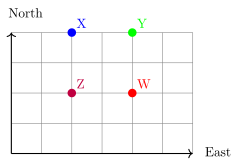
Question: Which point on the coordinate grid shows a location that is 4 units east and 2 units north?
- A. W
- B. X
- C. Y
- D. Z
- 4 units east is the x-coordinate, and 2 units north is the y-coordinate.
- This corresponds to point \((4, 2)\), which is W.
Answer: W
Real-World Word Problems
Problem 1
Question: A graph shows hours studied on the x-axis and test scores on the y-axis. Point \((5, 85)\) is plotted on the graph. What does this point represent?
- A. A student studied for 85 hours and scored 5 points
- B. A test took 5 hours and had 85 questions
- C. A student scored 5 points and studied for 85 hours
- D. A student studied for 5 hours and scored 85 points
Answer: A student studied for 5 hours and scored 85 points
Why it works: The x-coordinate represents hours studied (5 hours) and the y-coordinate represents the test score (85 points). So the point \((5, 85)\) means a student studied for 5 hours and earned a score of 85.
Problem 2
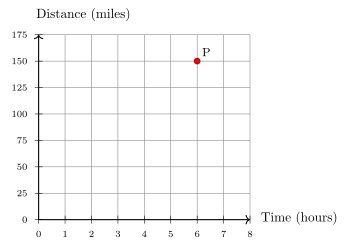
Question: On a time-distance graph, the x-axis shows time in hours and the y-axis shows distance in miles. A point is plotted on the graph. What does the plotted point represent?
- A. 6 hours, 150 miles
- B. 150 hours, 6 miles
- C. 150 hours, 150 miles
- D. 6 hours, 6 miles
Answer: 6 hours, 150 miles
Why it works: The plotted point is at 6 on the time axis and 150 on the distance axis. It represents 6 hours and 150 miles.
Common Mistakes
- Starting the computation before identifying what the numbers, units, or parts represent.
- Plotting the y-value first instead of reading the ordered pair in x-then-y order.
- Forgetting to estimate, which makes it easier to miss an unreasonable answer.
- Stopping at a number without explaining what the answer means in context.
Strategy Tips
- Read the situation slowly and name what each number or label represents.
- Use a model, table, chart, number line, or sketch before finishing the computation.
- Estimate first so you already know the answer's approximate size.
- Check the answer with an inverse operation, another representation, or a sentence explanation.
- Say the math idea out loud in simple words before writing the final answer.
Practice Questions
Question 1
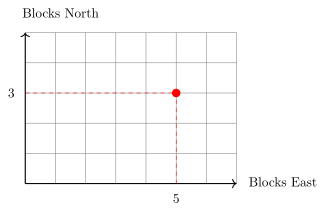
A point is located 5 blocks east and 3 blocks north from the origin. What are the coordinates of this point?
- A. \((3, 5)\)
- B. \((5, 8)\)
- C. \((8, 3)\)
- D. \((5, 3)\)
Question 2
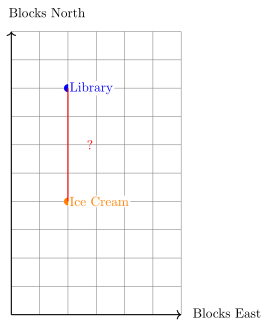
Maria's map shows that the ice cream shop is at point \((2, 4)\) and the library is at point \((2, 8)\). If each square on the map is one city block, how many blocks is the ice cream shop from the library?
- A. 2 blocks
- B. 8 blocks
- C. 6 blocks
- D. 4 blocks
Question 3
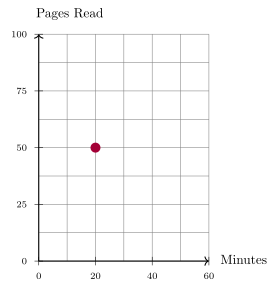
On a graph with minutes on the x-axis and pages read on the y-axis, a point at \((20, 50)\) means what?
- A. 50 minutes spent reading 20 pages
- B. 20 minutes spent reading 50 pages
- C. 70 minutes of reading time
- D. 20 pages in 50 minutes
Question 4
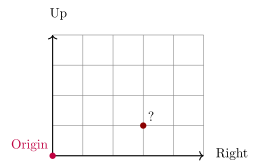
Which ordered pair represents the location 3 units right and 1 unit up from the origin?
- A. \((1, 3)\)
- B. \((4, 1)\)
- C. \((3, 3)\)
- D. \((3, 1)\)
Question 5
A bakery records the number of cupcakes sold each hour. The point \((4, 32)\) on the graph means the bakery sold how many cupcakes in 4 hours?
- A. 4 cupcakes
- B. 8 cupcakes
- C. 32 cupcakes
- D. 36 cupcakes
Question 6
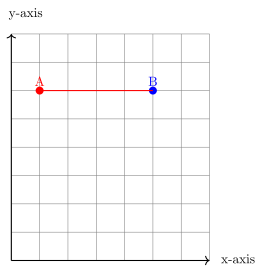
On a coordinate grid, point A is at \((1, 6)\) and point B is at \((5, 6)\). The two points are on the same:
- A. x-axis
- B. y-axis
- C. Horizontal line
- D. Vertical line
Full Answer Explanations Click to show all answers and explanations
Question 1
Answer: \((5, 3)\)
The x-coordinate is 5 (blocks east) and the y-coordinate is 3 (blocks north), so the coordinates are \((5, 3)\).
Question 2
Answer: 4 blocks
Both points have the same x-coordinate (2), so the distance is calculated using the y-coordinates: \(8 - 4 = 4\) blocks.
Question 3
Answer: 20 minutes spent reading 50 pages
The x-coordinate (20) represents minutes, and the y-coordinate (50) represents pages read. So 20 minutes of reading resulted in 50 pages.
Question 4
Answer: \((3, 1)\)
The first number tells how far to move right, and the second number tells how far to move up. Move \(3\) right and \(1\) up to get \((3,1)\).
Question 5
Answer: 32 cupcakes
The x-coordinate (4) is the number of hours, and the y-coordinate (32) is the number of cupcakes sold. So 32 cupcakes were sold.
Question 6
Answer: Horizontal line
Both points have the same y-coordinate (6), which means they lie on a horizontal line at height 6.
Connection to Standards
Solving Problems on the Coordinate Plane supports important Grade 5 math thinking because students are expected to students solve real-world problems that involve plotting and interpreting points on the coordinate plane. They connect graphing to patterns, measurement, and other mathematical concepts studied throughout the year.
Strong work in this topic means more than getting the answer. Students should be able to model the idea, explain the reasoning, choose an efficient strategy, and apply the concept in classwork and real situations.
Summary
Solving Problems on the Coordinate Plane gets easier when students read the model, track what each number means, and explain why the answer fits the situation.
GOLDEN RULE
Read x first, y second, and connect every point to its meaning.