





Introduction
In Grade 5, use operations on fractions to solve problems involving information presented in line plots. They find total amounts, differences, and averages from the fractional data displayed.
Solving Problems Using Line Plots matters because it blends concept understanding, visual reasoning, and accurate practice. When students can explain the math, model it, and apply it in context, they build confidence that carries into quizzes, classwork, and bigger Grade 5 problem solving.
What Is Solving Problems Using Line Plots?
Solving Problems Using Line Plots is the Grade 5 skill of students use operations on fractions to solve problems involving information presented in line plots. They find total amounts, differences, and averages from the fractional data displayed.
Strong understanding comes from naming what the numbers, shapes, units, or data values represent, then showing the idea with a model or clear steps before solving.
Understanding Solving Problems Using Line Plots
The key to this topic is understanding the structure behind the work, not just following a rule. Students should be able to talk through what is happening, point to a model, and explain why the answer makes sense.
- Identify what each number, unit, or symbol means before solving.
- Choose a model or strategy that makes the relationship visible.
- Explain why the answer fits the situation instead of stopping at computation.
- Use the topic language from class discussions: Students use operations on fractions to solve problems involving information presented in line plots. They find total amounts, differences, and averages from the fractional data displayed.
Visual Models
Visual Model 1
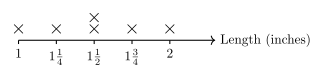
Question: The line plot below shows lengths of ribbon pieces, in inches, collected by an art club: The club uses only the pieces longer than \(1\frac{1}{2}\) inches. What is the total length of those pieces?
- A. \(3\frac{3}{4}\) inches
- B. \(4\frac{1}{2}\) inches
- C. \(5\frac{3}{4}\) inches
- D. \(6\frac{1}{2}\) inches
How the model helps: The pieces longer than \(1\frac{1}{2}\) inches are one piece of \(1\frac{3}{4}\) inches and one piece of \(2\) inches. Their total length is \(1\frac{3}{4}+2=3\frac{3}{4}\) inches.
Visual Model 2
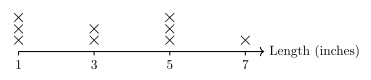
Question: The line plot shows the lengths (in inches) of ribbons collected by the art club: If the total ribbon length is shared equally among 4 posters, how much ribbon goes on each poster?
- A. \(7\frac{1}{4}\) inches
- B. \(7\frac{1}{2}\) inches
- C. \(7\frac{3}{4}\) inches
- D. \(8\) inches
How the model helps: Add the ribbon lengths shown by the marks: \((1 \times 3) + (3 \times 2) + (5 \times 3) + (7 \times 1) = 31\) inches. Sharing 31 inches equally among 4 posters gives \(31 \div 4 = 7\frac{3}{4}\) inches per poster.
Step-by-Step Examples
Example 1
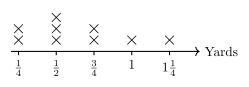
Question: The line plot shows lengths of ribbon pieces, in yards: What is the total length of all the ribbon pieces?
- A. \(5\frac{1}{4}\) yards
- B. \(5\frac{3}{4}\) yards
- C. \(6\frac{1}{4}\) yards
- D. \(6\frac{3}{4}\) yards
- Add the ribbon lengths shown: \(2(\frac{1}{4})+3(\frac{1}{2})+2(\frac{3}{4})+1+1\frac{1}{4}=5\frac{3}{4}\) yards.
Answer: \(5\frac{3}{4}\) yards
Example 2
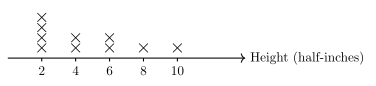
Question: The line plot shows the heights (in half-inches) of plant seedlings in a garden: What is the total height of all seedlings in inches?
- A. 21 inches
- B. 22 inches
- C. 23 inches
- D. 24 inches
- The labels are in half-inches.
- The total is \((2 \times 4) + (4 \times 2) + (6 \times 2) + (8 \times 1) + (10 \times 1) = 46\) half-inches.
- Since 2 half-inches make 1 inch, \(46 \div 2 = 23\) inches.
Answer: 23 inches
Example 3
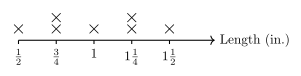
Question: The line plot shows lengths of ribbon pieces, in inches: What is the total length of the pieces longer than \(1\) inch?
- A. \(2\frac{3}{4}\) inches
- B. \(6\frac{1}{2}\) inches
- C. \(5\) inches
- D. \(4\) inches
- The pieces longer than \(1\) inch are two pieces of \(1\frac{1}{4}\) inches and one piece of \(1\frac{1}{2}\) inches.
- Their total is \(1\frac{1}{4}+1\frac{1}{4}+1\frac{1}{2}=4\) inches.
Answer: \(4\) inches
Real-World Word Problems
Problem 1
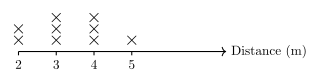
Question: The line plot shows distances (in meters) students jumped: What is the range of the data?
- A. 2 meters
- B. 3 meters
- C. 4 meters
- D. 5 meters
Answer: 3 meters
Why it works: Lowest: 2 m (2 marks), Highest: 5 m (1 mark). Range = \(5 - 2 = 3\) meters.
Problem 2
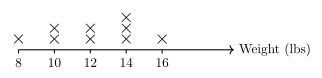
Question: The line plot shows the weight (in pounds) of puppies at the shelter: Each puppy gets \(\frac{1}{2}\) cup of food. How many cups of food are needed for all the puppies?
- A. \(4\) cups
- B. \(5\frac{1}{2}\) cups
- C. \(5\) cups
- D. \(4\frac{1}{2}\) cups
Answer: \(4\frac{1}{2}\) cups
Why it works: Count the puppies first: \(1 + 2 + 2 + 3 + 1 = 9\) puppies. Each puppy gets \(\frac{1}{2}\) cup, so \(9 \times \frac{1}{2} = 4\frac{1}{2}\) cups.
Common Mistakes
- Starting the computation before identifying what the numbers, units, or parts represent.
- Skipping the model or visual and relying only on a memorized rule.
- Forgetting to estimate, which makes it easier to miss an unreasonable answer.
- Stopping at a number without explaining what the answer means in context.
Strategy Tips
- Read the situation slowly and name what each number or label represents.
- Use a model, table, chart, number line, or sketch before finishing the computation.
- Estimate first so you already know the answer's approximate size.
- Check the answer with an inverse operation, another representation, or a sentence explanation.
- Say the math idea out loud in simple words before writing the final answer.
Practice Questions
Question 1
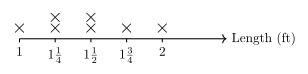
The line plot shows the lengths, in feet, of boards used for a project: What is the total length of all the boards?
- A. \(8\) feet
- B. \(11\frac{1}{2}\) feet
- C. \(10\) feet
- D. \(9\frac{1}{4}\) feet
Question 2
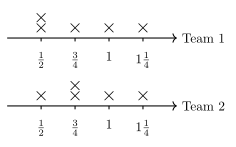
Two line plots show ribbon lengths, in yards, used by two teams: How much more ribbon did Team 2 use than Team 1?
- A. \(\frac{1}{4}\) yard
- B. \(\frac{1}{2}\) yard
- C. \(\frac{3}{4}\) yard
- D. \(1\) yard
Question 3
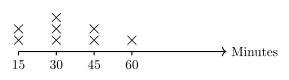
The line plot shows times (in minutes) students spent on homework: How many more students spent 30 minutes than 60 minutes on homework?
- A. 2 more students
- B. 3 more students
- C. 4 more students
- D. 5 more students
Question 4
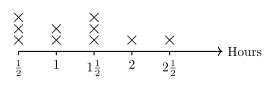
The line plot shows the number of hours students exercise per week: What is the total number of hours shown in the line plot?
- A. \(12\frac{1}{2}\) hours
- B. \(10\) hours
- C. \(25\) hours
- D. \(6\frac{1}{4}\) hours
Question 5
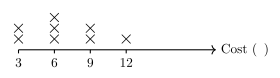
The line plot shows the cost (in dollars) of items bought at a shop: How many items cost less than $9?
- A. 5 items
- B. 6 items
- C. 7 items
- D. 8 items
Question 6
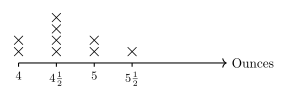
The line plot shows the amount of juice in several small cups, in ounces: If all the juice is divided into \(\frac{1}{2}\)-ounce servings, how many servings can be made?
- A. 82 servings
- B. 83 servings
- C. 84 servings
- D. 85 servings
Full Answer Explanations Click to show all answers and explanations
Question 1
Answer: \(9\frac{1}{4}\) feet
Add the board lengths: \(1 + 2(1\frac{1}{4}) + 2(1\frac{1}{2}) + 1\frac{3}{4} + 2 = 9\frac{1}{4}\) feet.
Question 2
Answer: \(\frac{1}{4}\) yard
Team 1 used \(\frac{1}{2}+\frac{1}{2}+\frac{3}{4}+1+1\frac{1}{4}=4\) yards. Team 2 used \(\frac{1}{2}+\frac{3}{4}+\frac{3}{4}+1+1\frac{1}{4}=4\frac{1}{4}\) yards. The difference is \(\frac{1}{4}\) yard.
Question 3
Answer: 2 more students
At 30 minutes: 3 marks. At 60 minutes: 1 mark. Difference: \(3 - 1 = 2\) more students.
Question 4
Answer: \(12\frac{1}{2}\) hours
Add the fractional measurements shown: \(3(\frac{1}{2})+2(1)+3(1\frac{1}{2})+2+2\frac{1}{2}=12\frac{1}{2}\) hours.
Question 5
Answer: 5 items
Items at \(3: 2, Items at \)6: 3. Total: \(2 + 3 = 5\) items cost less than $9.
Question 6
Answer: 83 servings
The plot shows \(41\frac{1}{2}\) ounces of juice in all: \((4 \times 2) + (4\frac{1}{2} \times 4) + (5 \times 2) + (5\frac{1}{2} \times 1)=41\frac{1}{2}\). Each serving is \(\frac{1}{2}\) ounce, so \(41\frac{1}{2} \div \frac{1}{2} = 83\) servings.
Connection to Standards
Solving Problems Using Line Plots supports important Grade 5 math thinking because students are expected to students use operations on fractions to solve problems involving information presented in line plots. They find total amounts, differences, and averages from the fractional data displayed.
Strong work in this topic means more than getting the answer. Students should be able to model the idea, explain the reasoning, choose an efficient strategy, and apply the concept in classwork and real situations.
Summary
Solving Problems Using Line Plots gets easier when students read the model, track what each number means, and explain why the answer fits the situation.
GOLDEN RULE
Understand the structure first, then solve, check, and explain why the answer makes sense.