




Introduction
In Grade 5, recognize that volume is additive and find the volume of solid figures composed of two non-overlapping right rectangular prisms. They decompose complex figures into simpler parts and add the volumes.
Volume of Composite Figures matters because it blends concept understanding, visual reasoning, and accurate practice. When students can explain the math, model it, and apply it in context, they build confidence that carries into quizzes, classwork, and bigger Grade 5 problem solving.
What Is Volume of Composite Figures?
Volume of Composite Figures is the Grade 5 skill of students recognize that volume is additive and find the volume of solid figures composed of two non-overlapping right rectangular prisms. They decompose complex figures into simpler parts and add the volumes.
Strong understanding comes from naming what the numbers, shapes, units, or data values represent, then showing the idea with a model or clear steps before solving.
Understanding Volume of Composite Figures
The key to this topic is understanding the structure behind the work, not just following a rule. Students should be able to talk through what is happening, point to a model, and explain why the answer makes sense.
- Think in layers of equal-sized cubes instead of only memorizing a formula.
- Connect length, width, and height to the number of cubes in each layer.
- Decide whether the figure can be decomposed into smaller rectangular prisms.
- Use the topic language from class discussions: Students recognize that volume is additive and find the volume of solid figures composed of two non-overlapping right rectangular prisms. They decompose complex figures into simpler parts and add the volumes.
Visual Models
Visual Model 1
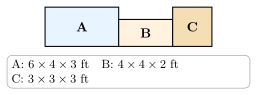
Question: A step-shaped solid is decomposed into three non-overlapping rectangular prisms. The prisms measure \(6\) feet by \(4\) feet by \(3\) feet, \(4\) feet by \(4\) feet by \(2\) feet, and \(3\) feet by \(3\) feet by \(3\) feet. What is the total volume?
- A. 104 cubic feet
- B. 131 cubic feet
- C. 59 cubic feet
- D. 99 cubic feet
How the model helps: Work one prism at a time: \(6 \times 4 \times 3 = 72\), \(4 \times 4 \times 2 = 32\), and \(3 \times 3 \times 3 = 27\). Add the non-overlapping volumes: \(72 + 32 + 27 = 131\) cubic feet.
Visual Model 2
Question: A composite solid is decomposed into three non-overlapping rectangular-prism parts. The dimensions of each part are shown in centimeters. Select all expressions that correctly find the volume of one part.
| Part | Length | Width | Height |
|---|---|---|---|
| A | 4 | 5 | 3 |
| B | 6 | 4 | 2 |
| C | 3 | 3 | 3 |
- A. \(4 \times 5 \times 3 = 60\)
- B. \(6 \times 4 \times 2 = 48\)
- C. \(3 \times 3 \times 3 = 27\)
- D. \(5 + 4 + 3 = 12\)
How the model helps: The table gives three dimensions for each rectangular-prism part. Each correct expression multiplies length, width, and height to find cubic units. Choice D adds side lengths, so it does not find volume.
Step-by-Step Examples
Example 1
Question: A composite stage platform is made from two non-overlapping rectangular prisms. Prism A is \(4\) centimeters long, \(2\) centimeters wide, and \(2\) centimeters tall. Prism B is \(3\) centimeters long, \(3\) centimeters wide, and \(1\) centimeter tall. What is the total volume?
- A. 25 cubic centimeters
- B. 16 cubic centimeters
- C. 9 cubic centimeters
- D. 33 cubic centimeters
- Find each part first: Prism A is \(4 \times 2 \times 2 = 16\) cubic centimeters, and Prism B is \(3 \times 3 \times 1 = 9\) cubic centimeters.
- Because the parts do not overlap, add them: \(16 + 9 = 25\) cubic centimeters.
Answer: 25 cubic centimeters
Example 2
Question: A composite classroom model is made from two non-overlapping rectangular prisms. Prism A is \(5\) inches long, \(4\) inches wide, and \(5\) inches tall. Prism B is \(6\) inches long, \(4\) inches wide, and \(3\) inches tall. What is the total volume?
- A. 100 cubic inches
- B. 172 cubic inches
- C. 72 cubic inches
- D. 192 cubic inches
- Find each part first: Prism A is \(5 \times 4 \times 5 = 100\) cubic inches, and Prism B is \(6 \times 4 \times 3 = 72\) cubic inches.
- Because the parts do not overlap, add them: \(100 + 72 = 172\) cubic inches.
Answer: 172 cubic inches
Example 3
Question: A composite storage display is made from two non-overlapping rectangular prisms. Prism A is \(6\) feet long, \(2\) feet wide, and \(3\) feet tall. Prism B is \(3\) feet long, \(5\) feet wide, and \(5\) feet tall. What is the total volume?
- A. 36 cubic feet
- B. 75 cubic feet
- C. 111 cubic feet
- D. 123 cubic feet
- Find each part first: Prism A is \(6 \times 2 \times 3 = 36\) cubic feet, and Prism B is \(3 \times 5 \times 5 = 75\) cubic feet.
- Because the parts do not overlap, add them: \(36 + 75 = 111\) cubic feet.
Answer: 111 cubic feet
Real-World Word Problems
Problem 1
Question: A composite museum stand is made from two non-overlapping rectangular prisms. Prism A is \(7\) meters long, \(4\) meters wide, and \(6\) meters tall. Prism B is \(6\) meters long, \(2\) meters wide, and \(2\) meters tall. What is the total volume?
- A. 168 cubic meters
- B. 24 cubic meters
- C. 220 cubic meters
- D. 192 cubic meters
Answer: 192 cubic meters
Why it works: Find each part first: Prism A is \(7 \times 4 \times 6 = 168\) cubic meters, and Prism B is \(6 \times 2 \times 2 = 24\) cubic meters. Because the parts do not overlap, add them: \(168 + 24 = 192\) cubic meters.
Problem 2
Question: A composite garden block is made from two non-overlapping rectangular prisms. Prism A is \(8\) centimeters long, \(2\) centimeters wide, and \(4\) centimeters tall. Prism B is \(3\) centimeters long, \(3\) centimeters wide, and \(4\) centimeters tall. What is the total volume?
- A. 100 cubic centimeters
- B. 64 cubic centimeters
- C. 36 cubic centimeters
- D. 116 cubic centimeters
Answer: 100 cubic centimeters
Why it works: Find each part first: Prism A is \(8 \times 2 \times 4 = 64\) cubic centimeters, and Prism B is \(3 \times 3 \times 4 = 36\) cubic centimeters. Because the parts do not overlap, add them: \(64 + 36 = 100\) cubic centimeters.
Common Mistakes
- Starting the computation before identifying what the numbers, units, or parts represent.
- Confusing area and volume or forgetting that volume is measured in cubic units.
- Forgetting to estimate, which makes it easier to miss an unreasonable answer.
- Stopping at a number without explaining what the answer means in context.
Strategy Tips
- Read the situation slowly and name what each number or label represents.
- Think in layers of cubes or base-area groups before using a formula.
- Estimate first so you already know the answer's approximate size.
- Check the answer with an inverse operation, another representation, or a sentence explanation.
- Say the math idea out loud in simple words before writing the final answer.
Practice Questions
Question 1
A composite science fair model is made from two non-overlapping rectangular prisms. Prism A is \(9\) inches long, \(4\) inches wide, and \(2\) inches tall. Prism B is \(6\) inches long, \(4\) inches wide, and \(1\) inches tall. What is the total volume?
- A. 72 cubic inches
- B. 96 cubic inches
- C. 24 cubic inches
- D. 132 cubic inches
Question 2
A composite bookcase base is made from two non-overlapping rectangular prisms. Prism A is \(4\) feet long, \(2\) feet wide, and \(5\) feet tall. Prism B is \(3\) feet long, \(5\) feet wide, and \(3\) feet tall. What is the total volume?
- A. 40 cubic feet
- B. 45 cubic feet
- C. 85 cubic feet
- D. 93 cubic feet
Question 3
A composite play structure is made from two non-overlapping rectangular prisms. Prism A is \(5\) meters long, \(4\) meters wide, and \(3\) meters tall. Prism B is \(6\) meters long, \(2\) meters wide, and \(5\) meters tall. What is the total volume?
- A. 60 cubic meters
- B. 140 cubic meters
- C. 130 cubic meters
- D. 120 cubic meters
Question 4
A composite shipping stack is made from two non-overlapping rectangular prisms. Prism A is \(6\) centimeters long, \(2\) centimeters wide, and \(6\) centimeters tall. Prism B is \(3\) centimeters long, \(3\) centimeters wide, and \(2\) centimeters tall. What is the total volume?
- A. 90 cubic centimeters
- B. 72 cubic centimeters
- C. 18 cubic centimeters
- D. 102 cubic centimeters
Question 5
A composite art display is made from two non-overlapping rectangular prisms. Prism A is \(7\) inches long, \(4\) inches wide, and \(4\) inches tall. Prism B is \(6\) inches long, \(4\) inches wide, and \(4\) inches tall. What is the total volume?
- A. 112 cubic inches
- B. 236 cubic inches
- C. 96 cubic inches
- D. 208 cubic inches
Question 6
A composite stage platform is made from two non-overlapping rectangular prisms. Prism A is \(8\) feet long, \(2\) feet wide, and \(2\) feet tall. Prism B is \(3\) feet long, \(5\) feet wide, and \(1\) feet tall. What is the total volume?
- A. 32 cubic feet
- B. 15 cubic feet
- C. 47 cubic feet
- D. 63 cubic feet
Full Answer Explanations Click to show all answers and explanations
Question 1
Answer: 96 cubic inches
Find each part first: Prism A is \(9 \times 4 \times 2 = 72\) cubic inches, and Prism B is \(6 \times 4 \times 1 = 24\) cubic inches. Because the parts do not overlap, add them: \(72 + 24 = 96\) cubic inches.
Question 2
Answer: 85 cubic feet
Find each part first: Prism A is \(4 \times 2 \times 5 = 40\) cubic feet, and Prism B is \(3 \times 5 \times 3 = 45\) cubic feet. Because the parts do not overlap, add them: \(40 + 45 = 85\) cubic feet.
Question 3
Answer: 120 cubic meters
Find each part first: Prism A is \(5 \times 4 \times 3 = 60\) cubic meters, and Prism B is \(6 \times 2 \times 5 = 60\) cubic meters. Because the parts do not overlap, add them: \(60 + 60 = 120\) cubic meters.
Question 4
Answer: 90 cubic centimeters
Find each part first: Prism A is \(6 \times 2 \times 6 = 72\) cubic centimeters, and Prism B is \(3 \times 3 \times 2 = 18\) cubic centimeters. Because the parts do not overlap, add them: \(72 + 18 = 90\) cubic centimeters.
Question 5
Answer: 208 cubic inches
Find each part first: Prism A is \(7 \times 4 \times 4 = 112\) cubic inches, and Prism B is \(6 \times 4 \times 4 = 96\) cubic inches. Because the parts do not overlap, add them: \(112 + 96 = 208\) cubic inches.
Question 6
Answer: 47 cubic feet
Find each part first: Prism A is \(8 \times 2 \times 2 = 32\) cubic feet, and Prism B is \(3 \times 5 \times 1 = 15\) cubic feet. Because the parts do not overlap, add them: \(32 + 15 = 47\) cubic feet.
Connection to Standards
Volume of Composite Figures supports important Grade 5 math thinking because students are expected to students recognize that volume is additive and find the volume of solid figures composed of two non-overlapping right rectangular prisms. They decompose complex figures into simpler parts and add the volumes.
Strong work in this topic means more than getting the answer. Students should be able to model the idea, explain the reasoning, choose an efficient strategy, and apply the concept in classwork and real situations.
Summary
Volume of Composite Figures gets easier when students read the model, track what each number means, and explain why the answer fits the situation.
GOLDEN RULE
Think in layers of cubic units, then justify the formula with the model.