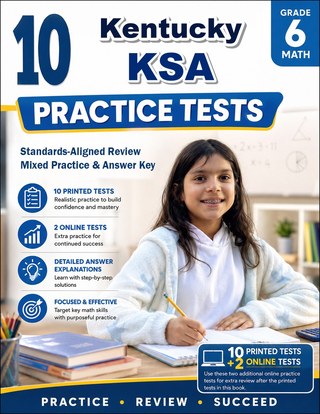





The Kentucky KSA Grade 6 Math test is an important checkpoint because sixth grade math asks students to connect reasoning, computation, algebraic thinking, geometry, and data analysis. Students are expected to do more than get an answer. They need to read carefully, choose efficient strategies, explain relationships, and check whether results make sense.
This guide gives parents, teachers, tutors, and students a clear preparation path for Kentucky KSA Grade 6 Math. It covers the main skills, a 4-week study plan, a daily practice routine, common mistakes, sample questions with explanations, test-day strategies, Grade 6 lessons, quizzes, and a timed practice-test link.
What Is the KSA Grade 6 Math Test?
The KSA Grade 6 Math test measures how well students can use sixth-grade math in problem-solving situations. A student may need to find a unit rate, solve a percent problem, divide fractions, compare rational numbers, write an expression, solve an equation, find area or volume, or interpret a data display.
Grade 6 is a transition year. Students move from arithmetic-only work toward ratio reasoning, negative numbers, early algebra, and statistical thinking. Preparation should help students understand why a method works, not just memorize steps.
The best preparation is steady practice. Students need repeated exposure to mixed questions, organized scratch work, and time to review mistakes. When students learn from errors, every missed question becomes part of the study plan.
Kentucky KSA Grade 6 Math Skills Covered
A strong preparation plan reviews the skills that support many different test questions. Students should practice these skills as connected ideas, not isolated tricks.
Ratios, Rates, and Percents
Students should describe ratios, use ratio tables, find unit rates, graph ratio relationships, convert between fractions, decimals, and percents, and solve real-world percent problems.
Fraction, Decimal, and Multi-Digit Operations
Students should divide fractions by fractions, compute fluently with decimals, use greatest common factor and least common multiple, and apply operations in word problems.
Rational Numbers and the Coordinate Plane
Students should understand positive and negative numbers, opposites, absolute value, rational numbers on a number line, ordered pairs, and distances on the coordinate plane.
Expressions, Equations, and Inequalities
Students should translate words into expressions, identify terms and coefficients, evaluate expressions, write equivalent expressions, solve one-step equations, and graph inequalities.
Geometry, Measurement, and Data
Students should find area of triangles, parallelograms, and trapezoids, solve volume and surface-area problems, use coordinate-plane geometry, describe statistical questions, compare mean and median, measure spread, and read dot plots, histograms, box plots, stem-and-leaf plots, and circle graphs.
Best 4-Week KSA Study Plan
A 4-week plan gives students enough time to review, practice, and improve without feeling rushed. The goal is steady confidence.
Week 1: Ratios, Rates, Percents, Fractions, and Decimals
- Review ratio language, equivalent ratios, ratio tables, and unit rates.
- Practice percent problems with simple real-world contexts.
- Review fraction division and decimal operations.
- Solve at least five mixed word problems during the week.
Week 2: Rational Numbers and Algebraic Thinking
- Practice positive and negative numbers on number lines.
- Compare and order rational numbers.
- Evaluate expressions and identify terms, factors, and coefficients.
- Solve one-step equations and graph simple inequalities.
Week 3: Geometry, Measurement, and Coordinate Reasoning
- Find area of triangles, parallelograms, trapezoids, and composite figures.
- Review volume and surface area of rectangular prisms.
- Practice coordinate-plane problems involving points, distances, and polygons.
- Use diagrams and labels carefully so units are not lost.
Week 4: Statistics, Mixed Practice, and Error Review
- Review statistical questions, measures of center, spread, and data displays.
- Take a timed mixed practice set early in the week.
- Make an error log with skill, mistake, corrected solution, and retry problem.
- Review the weakest three skills before test day.
A Simple Daily Practice Routine
Grade 6 students often do best with short, consistent practice. A focused 30-minute routine is usually more useful than one long session.
- Warm up for 5 minutes. Review a quick ratio, decimal, integer, or equation problem.
- Study one skill for 10 minutes. Use a model, worked example, or short lesson.
- Practice 8 to 12 questions for 15 minutes. Include at least two word problems.
- Review mistakes for 5 minutes. Ask what went wrong and how the student will avoid that mistake next time.
Common Grade 6 Math Mistakes
- Mixing up ratios and fractions: Students should identify what each quantity represents before simplifying.
- Forgetting the unit in a unit rate: A unit rate should describe one unit, such as miles per hour or dollars per item.
- Decimal place-value errors: Students should estimate before calculating so answers feel reasonable.
- Sign mistakes with negative numbers: Number lines help students check direction and distance.
- Solving only part of a word problem: Multi-step problems often require more than one operation.
- Confusing area, surface area, and volume: Area uses square units, surface area adds outside faces, and volume uses cubic units.
- Reading data displays too quickly: Students should check labels, scales, intervals, and what each point or bar represents.
KSA Grade 6 Math Practice Questions
These sample questions match the kinds of Grade 6 reasoning students should practice. Have students solve first, then read the explanation.
Question 1: Unit Rate
A runner travels 12 miles in 3 hours. What is the unit rate in miles per hour?
Answer: 4 miles per hour.
Explanation: Divide total miles by total hours. \(12 \div 3 = 4\), so the runner travels 4 miles in 1 hour.
Question 2: Percent
A class has 25 students. If 40% of the students brought lunch from home, how many students brought lunch?
Answer: 10 students.
Explanation: 40% means 40 out of 100, or 0.40. \(0.40 \times 25 = 10\).
Question 3: Fraction Division
How many \(\frac{1}{4}\)-cup servings are in \(\frac{3}{2}\) cups?
Answer: 6 servings.
Explanation: Divide \(\frac{3}{2} \div \frac{1}{4}\). This asks how many fourths are in one and one-half. There are 6 fourths.
Question 4: Integers
The temperature was -5°F in the morning and rose 12 degrees by afternoon. What was the afternoon temperature?
Answer: 7°F.
Explanation: Rising 12 degrees means add 12. \(-5 + 12 = 7\).
Question 5: Equation
Solve \(x + 8 = 21\).
Answer: \(x = 13\).
Explanation: Subtract 8 from both sides. \(21 - 8 = 13\).
Question 6: Data
The numbers 6, 8, 8, 10, and 13 show quiz scores. What is the median?
Answer: 8.
Explanation: The numbers are already in order. The middle value is 8.
How to Improve KSA Math Scores
The fastest improvement usually comes from reviewing mistakes carefully. Instead of only marking an answer wrong, students should identify the mistake type. Was it a reading mistake, operation mistake, sign mistake, unit-rate mistake, equation mistake, graph mistake, or data-display mistake?
Use an error log with four columns: skill, mistake, corrected solution, and retry problem. Then give the student two or three similar problems before moving to a new topic. This turns practice into targeted improvement.
KSA Math Test-Day Strategies
- Read each question twice before solving.
- Underline what the question asks.
- Write units for ratio, rate, measurement, area, volume, and data questions.
- Estimate before choosing an answer when possible.
- For integer problems, use a number line to check direction.
- For equations, substitute the answer back into the original equation.
- If the test platform allows it, flag hard questions and return later.
Lessons, Quizzes, and Kentucky KSA Grade 6 Math Review
Use focused lessons first, then mixed practice. Lessons help students understand the skill; quizzes and practice tests help students build speed, confidence, and test-style stamina.
- Grade 6 What Is a Ratio?
- Grade 6 Using Ratio Language
- Grade 6 What Is a Rate?
- Grade 6 Finding the Unit Rate
- Grade 6 What Is a Percent?
- Grade 6 Solving Percent Problems
- Grade 6 Solving Rate and Ratio Word Problems
- Grade 6 Dividing Fractions by Fractions
- Grade 6 Decimal Operations
- Grade 6 Understanding Positive and Negative Numbers
- Grade 6 Rational Numbers on the Number Line
- Grade 6 The Coordinate Plane
- Grade 6 Exponents and Order of Operations
- Grade 6 Translating Words into Expressions
- Grade 6 Solving One-Step Equations
- Grade 6 Writing Inequalities
- Grade 6 Area of Triangles
- Grade 6 Area of Parallelograms and Trapezoids
- Grade 6 Volume of Rectangular Prisms
- Grade 6 Nets and Surface Area
- Grade 6 Statistical Questions
- Grade 6 Mean and Median
- Grade 6 Measures of Spread
- Grade 6 Box Plots
Timed Grade 6 practice
Try a Kentucky KSA Grade 6 Math Practice Test
Use this online practice test after the study guide. It opens in a new tab so students can practice without losing this preparation plan.
Grade 6 skill quizzes
Practice the skills that show up across Grade 6 math tests
Open these quizzes in a new tab after reviewing the study guide. They are useful for focused practice before a full state assessment review.
Need Kentucky Grade 6 Math practice?
Browse Testinar Grade 6 math resources for Kentucky. Use lessons and quizzes as weekly checkpoints while students build confidence for the KSA.
FAQ: Kentucky KSA Grade 6 Math Preparation
Is the Kentucky KSA Grade 6 Math test difficult?
It can feel challenging because Grade 6 math combines ratios, rates, percents, fractions, decimals, integers, expressions, equations, geometry, and statistics. A steady plan makes the KSA much more manageable.
What should students study first for Kentucky KSA Grade 6 Math?
Start with ratios, unit rates, fraction and decimal operations, rational numbers, one-step equations, inequalities, area, volume, and data displays. These skills support many Grade 6 test questions.
How long should students prepare for the KSA Grade 6 Math test?
Four focused weeks is a strong starting point. Students should review core skills, practice mixed questions, analyze mistakes, and complete at least one timed practice test before test day.
Are calculators allowed on the Kentucky Grade 6 math assessment?
Calculator, tool, and accommodation rules can vary by state, school year, testing platform, and student plan. Families should confirm current KSA rules with the school, district, or official state assessment guidance.
How can students improve their KSA math score quickly?
Use an error log. For each missed question, write the tested skill, the mistake, the corrected solution, and one similar retry problem. This turns practice into targeted improvement.
What is the best way to use Grade 6 Math practice tests?
Use a practice test as a checkpoint, not the whole study plan. Take the test, review missed questions by skill, reteach weak areas, practice similar problems, and then retest later.
Summary
Preparing for Kentucky KSA Grade 6 Math works best when students review core skills, practice consistently, analyze mistakes, and use quizzes or timed practice tests to build confidence. The goal is not last-minute memorization. The goal is steady problem solving, careful reading, and calm test readiness.