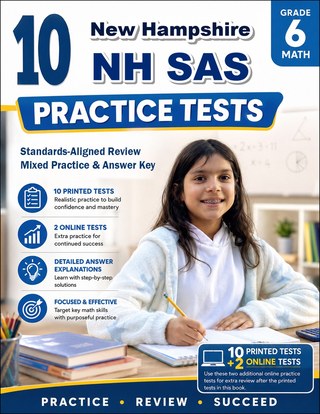





The best New Hampshire NH SAS Grade 6 Math study plan is steady, organized, and built around the skills students actually need: ratios, rates, percents, fraction and decimal operations, rational numbers, equations, geometry, statistics, and mixed word problems.
This 4-week plan helps families move from diagnosis to focused review, then to mixed practice and timed readiness checks without overwhelming the student.
Best New Hampshire NH SAS Grade 6 Math 4-Week Study Plan
This plan is built around the Grade 6 math skills that most often need steady review: ratios, unit rates, percents, fraction and decimal operations, rational numbers, expressions, equations, inequalities, geometry, and statistics.
Week 1
Diagnose Skills and Rebuild Ratios, Rates, and Percents
Focus: Baseline check, ratio language, equivalent ratios, unit rates, ratio tables, graphs, percent meaning, and percent word problems.
- Start with a short mixed review to find the baseline.
- Group missed questions by skill: ratios, rates, percents, operations, equations, geometry, or statistics.
- Use tables and double number lines before moving to faster unit-rate or percent shortcuts.
Student goal: Explain ratios, rates, and percents with words, tables, and equations.
Week 2
Strengthen Fraction, Decimal, and Rational-Number Reasoning
Focus: Fraction division, decimal operations, integers, absolute value, rational-number order, number lines, and coordinate-plane points.
- Have students estimate before computing with fractions and decimals.
- Use number lines to compare negative numbers and explain opposites.
- Practice coordinate-plane questions where ordered pairs may use positive and negative values.
Student goal: Compute accurately and explain why positive and negative numbers are ordered correctly.
Week 3
Practice Expressions, Equations, Inequalities, and Geometry
Focus: Writing expressions, evaluating variables, solving one-step equations, reading inequalities, area, volume, nets, and surface area.
- Ask students to write an expression or equation before solving.
- Review formulas with labeled diagrams instead of memorizing alone.
- Connect area, volume, and surface area problems to units and real-world meaning.
Student goal: Represent problems with equations, solve carefully, and label geometry answers correctly.
Week 4
Finish with Statistics, Mixed Practice, and Test Readiness
Focus: Statistical questions, data displays, measures of center, measures of spread, mixed review, pacing, and missed-question correction.
- Use box plots, dot plots, histograms, and tables to discuss what the data shows.
- Give mixed practice so students switch between skills without hints.
- Use one timed practice test as a readiness checkpoint, then review every missed question.
Student goal: Handle mixed Grade 6 math questions calmly and explain the reasoning behind answers.
Simple Daily Study Routine
A study session does not need to be long. For many Grade 6 students, 35 focused minutes works well when the work is organized and mistakes are reviewed carefully.
| Time | What to Do |
|---|---|
| 5 minutes | Warm up with mental math, estimation, integer comparisons, or fraction-decimal-percent conversions. |
| 10 minutes | Review one focused Grade 6 skill with a lesson or worked example. |
| 15 minutes | Solve 6 to 10 practice questions connected to that skill. |
| 5 minutes | Correct mistakes and write one sentence explaining what changed. |
How to Review Missed Questions
Missed questions are the most useful part of test prep. They show exactly what to review next. Do not only mark an answer wrong and move on.
- Write the skill next to the missed question.
- Redo the problem without looking at the answer.
- Explain the mistake in one sentence.
- Solve two similar problems right away.
- Retest that skill a few days later.
Standards connection
Connect the Study Plan to New Hampshire Grade 6 Math Standards
The plan works best when every missed question points to a skill. Use the standards guide and standards practice map to connect review, lessons, quizzes, and practice resources.
Skill lessons
Helpful Grade 6 Math Lessons for This Study Plan
Use these lessons when the plan shows that a student needs more review in a specific skill area.
- Grade 6 What Is a Ratio?
- Grade 6 Using Ratio Language
- Grade 6 What Is a Rate?
- Grade 6 Finding the Unit Rate
- Grade 6 Tables of Equivalent Ratios
- Grade 6 Graphing Ratios
- Grade 6 What Is a Percent?
- Grade 6 Solving Percent Problems
- Grade 6 Solving Rate and Ratio Word Problems
- Grade 6 Dividing Fractions by Fractions
- Grade 6 Decimal Operations
- Grade 6 Understanding Positive and Negative Numbers
- Grade 6 Rational Numbers on the Number Line
- Grade 6 The Coordinate Plane
- Grade 6 Comparing and Ordering Rational Numbers
- Grade 6 Exponents and Order of Operations
- Grade 6 Translating Words into Expressions
- Grade 6 Solving One-Step Equations
- Grade 6 Writing Inequalities
- Grade 6 Area of Triangles
- Grade 6 Area of Parallelograms and Trapezoids
- Grade 6 Volume of Rectangular Prisms
- Grade 6 Statistical Questions
- Grade 6 Measures of Spread
- Grade 6 Box Plots
Timed checkpoints
Use Grade 6 Skill Quizzes as Checkpoints
Use a quiz as a quick check, review missed questions, then return to another skill quiz after focused review. Each quiz opens in a new tab.
Full-length checkpoint
Use One Timed NH SAS Practice Test as a Checkpoint
After focused review, use one full-length practice test to check pacing, stamina, and mixed-skill readiness. Then review every missed question by skill.
New Hampshire NH SAS Grade 6 Math Practice Test 1 40 questions · 120 minutesRecommended resources
Printable Grade 6 Math Practice for New Hampshire
Next step
Turn the Plan into Test Readiness
Use this study plan with the test overview, practice questions, standards map, and complete preparation guide so students know what to study and how to check progress.
What is on the test? Practice questions Standards map Preparation guideSummary
The best New Hampshire NH SAS Grade 6 Math study plan is steady, focused, and built around mistake review. Start with a baseline, review the weakest skills, practice mixed questions, and use quiz checkpoints to measure progress. Students build confidence when they understand the strategy behind each answer.
FAQ
What is the best study plan for New Hampshire NH SAS Grade 6 Math?
The best plan starts with a baseline check, reviews weak skills in short sessions, uses quizzes as checkpoints, and finishes with mixed review plus careful missed-question correction.
How long should students study for the NH SAS Grade 6 Math test?
Four focused weeks works well for many students. If a student needs more time, stretch each week into two weeks and use the same sequence as an 8-week plan.
What Grade 6 math skills should students review first?
Start with ratios, unit rates, percents, fraction division, decimal operations, integers, rational numbers, expressions, equations, inequalities, geometry formulas, and data displays.
Should Grade 6 students take practice tests every day?
No. Practice tests should be checkpoints. Daily study should include focused skill review, a small set of practice questions, and careful correction of mistakes.
How should parents review missed math questions?
Have the student identify the skill, redo the problem, explain the mistake, solve two similar problems, and revisit that skill a few days later.
Can New Hampshire NH SAS Grade 6 test details change?
Yes. Test timing, tools, item types, and calculator policies can change. Use this plan as study support and confirm official details with your school or state education agency.