





Introduction
In Grade 5, divide a whole number by a unit fraction. For example, they find 4 ÷ 1/3 by determining how many 1/3-size portions fit into 4 wholes. They use visual models and relate division to multiplication.
Dividing Whole Numbers by Unit Fractions matters because it blends concept understanding, visual reasoning, and accurate practice. When students can explain the math, model it, and apply it in context, they build confidence that carries into quizzes, classwork, and bigger Grade 5 problem solving.
What Is Dividing Whole Numbers by Unit Fractions?
Dividing Whole Numbers by Unit Fractions is the Grade 5 skill of students divide a whole number by a unit fraction. For example, they find 4 ÷ 1/3 by determining how many 1/3-size portions fit into 4 wholes. They use visual models and relate division to multiplication.
Strong understanding comes from naming what the numbers, shapes, units, or data values represent, then showing the idea with a model or clear steps before solving.
Understanding Dividing Whole Numbers by Unit Fractions
The key to this topic is understanding the structure behind the work, not just following a rule. Students should be able to talk through what is happening, point to a model, and explain why the answer makes sense.
- Identify the whole first so every fraction part keeps the same meaning.
- Use equal parts, number lines, or area models to show the relationship.
- Check whether the answer should be larger, smaller, or equivalent before finishing.
- Use the topic language from class discussions: Students divide a whole number by a unit fraction. For example, they find 4 ÷ 1/3 by determining how many 1/3-size portions fit into 4 wholes. They use visual models and relate division to multiplication.
Visual Models
Visual Model 1
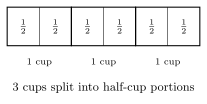
Question: How many one-half cups are in 3 cups?
- A. 9
- B. 6
- C. 3
- D. 12
How the model helps: \(3 \div \frac{1}{2} = 3 \times 2 = 6\). There are 6 half-cups in 3 cups.
Visual Model 2
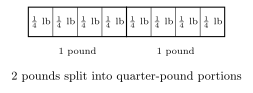
Question: A baker has 2 pounds of flour. She uses \(\frac{1}{4}\)-pound portions for each loaf. How many loaves can she make?
- A. 4
- B. 2
- C. 6
- D. 8
How the model helps: \(2 \div \frac{1}{4} = 2 \times 4 = 8\). She can make 8 loaves.
Step-by-Step Examples
Example 1
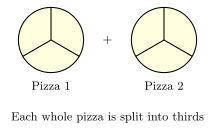
Question: How many one-third pizzas fit in 2 whole pizzas?
- A. 8
- B. 2
- C. 3
- D. 6
- \(2 \div \frac{1}{3} = 2 \times 3 = 6\).
- There are 6 one-third pizzas in 2 whole pizzas.
Answer: 6
Example 2
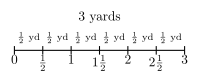
Question: Mrs. Chen has 3 yards of ribbon. She cuts it into \(\frac{1}{2}\)-yard pieces. How many pieces does she get?
- A. 3
- B. 6
- C. 4
- D. 9
- \(3 \div \frac{1}{2} = 3 \times 2 = 6\).
- She gets 6 pieces.
Answer: 6
Example 3
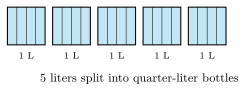
Question: A sports drink comes in bottles that hold \(\frac{1}{4}\) liter each. How many bottles can be filled from 5 liters?
- A. 20
- B. 10
- C. 15
- D. 25
- \(5 \div \frac{1}{4} = 5 \times 4 = 20\).
- We can fill 20 bottles.
Answer: 20
Real-World Word Problems
Problem 1
Question: A recipe calls for \(\frac{1}{3}\)-cup servings of sugar. How many servings are in 4 cups?
- A. 4
- B. 15
- C. 8
- D. 12
Answer: 12
Why it works: \(4 \div \frac{1}{3} = 4 \times 3 = 12\). There are 12 servings.
Problem 2
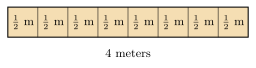
Question: A tailor has 4 meters of fabric. Each costume needs \(\frac{1}{2}\) meter. How many costumes can be made?
- A. 8
- B. 2
- C. 6
- D. 4
Answer: 8
Why it works: \(4 \div \frac{1}{2} = 4 \times 2 = 8\). She can make 8 costumes.
Common Mistakes
- Starting the computation before identifying what the numbers, units, or parts represent.
- Combining numerators and denominators without first checking whether the fraction pieces match in size.
- Forgetting to estimate, which makes it easier to miss an unreasonable answer.
- Stopping at a number without explaining what the answer means in context.
Strategy Tips
- Read the situation slowly and name what each number or label represents.
- Draw fraction bars, area models, or number lines so equal parts stay visible.
- Estimate first so you already know the answer's approximate size.
- Check the answer with an inverse operation, another representation, or a sentence explanation.
- Say the math idea out loud in simple words before writing the final answer.
Practice Questions
Question 1
What is \(5 \div \frac{1}{3}\)?
- A. \(\frac{5}{3}\)
- B. \(\frac{1}{15}\)
- C. 15
- D. 8
Question 2
What is \(4 \div \frac{1}{4}\)?
- A. 16
- B. 1
- C. 8
- D. 4
Question 3
What is \(6 \div \frac{1}{2}\)?
- A. 12
- B. 3
- C. 6
- D. 18
Question 4
What is \(7 \div \frac{1}{4}\)?
- A. 28
- B. 14
- C. 35
- D. 21
Question 5
What is \(8 \div \frac{1}{3}\)?
- A. 32
- B. 8
- C. 16
- D. 24
Question 6
What is \(9 \div \frac{1}{3}\)?
- A. 27
- B. 9
- C. 18
- D. 36
Full Answer Explanations Click to show all answers and explanations
Question 1
Answer: 15
Dividing by \(\frac{1}{3}\) asks how many one-third pieces are in 5 wholes. Each whole has 3 thirds, so \(5 \div \frac{1}{3} = 5 \times 3 = 15\).
Question 2
Answer: 16
\(4 \div \frac{1}{4} = 4 \times 4 = 16\). Multiply the whole number by the denominator.
Question 3
Answer: 12
\(6 \div \frac{1}{2} = 6 \times 2 = 12\).
Question 4
Answer: 28
\(7 \div \frac{1}{4} = 7 \times 4 = 28\).
Question 5
Answer: 24
\(8 \div \frac{1}{3} = 8 \times 3 = 24\).
Question 6
Answer: 27
\(9 \div \frac{1}{3} = 9 \times 3 = 27\).
Connection to Standards
Dividing Whole Numbers by Unit Fractions supports important Grade 5 math thinking because students are expected to students divide a whole number by a unit fraction. For example, they find 4 ÷ 1/3 by determining how many 1/3-size portions fit into 4 wholes. They use visual models and relate division to multiplication.
Strong work in this topic means more than getting the answer. Students should be able to model the idea, explain the reasoning, choose an efficient strategy, and apply the concept in classwork and real situations.
Summary
Dividing Whole Numbers by Unit Fractions gets easier when students read the model, track what each number means, and explain why the answer fits the situation.
GOLDEN RULE
Keep the whole consistent, show equal parts clearly, and explain what the fraction means.