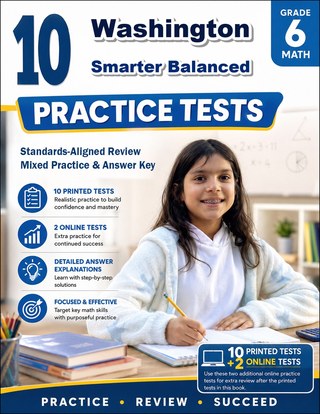





Families often ask what will actually appear on the Washington Smarter Balanced Grade 6 Math test. The exact format can change, but the major Grade 6 math skills are clear: students need ratio reasoning, unit rates, percents, fraction and decimal operations, rational numbers, expressions, equations, geometry, and statistics.
This guide explains the main skill areas, the question types students may see, and how to use Grade 6 lessons, quizzes, and a timed practice test to prepare with confidence.
Grade 6 Math Skills Covered
The Smarter Balanced Grade 6 Math test is designed to measure whether students can use grade-level math independently. Students should be ready for direct skill questions and mixed problems that require reasoning.
Ratios, Rates, and Percents
Skills: Use ratio language, equivalent ratios, ratio tables, unit rates, graphs, fractions, decimals, and percents.
Example: Students may find a unit price, compare two rates, or solve a percent-of-a-number problem.
Fractions, Decimals, GCF, and LCM
Skills: Divide fractions, compute with multi-digit decimals, use greatest common factor, and use least common multiple.
Example: Students may divide two fractions in a word problem or use GCF to rewrite an expression.
Rational Numbers and the Coordinate Plane
Skills: Understand positive and negative numbers, opposites, absolute value, rational-number order, ordered pairs, and distance.
Example: Students may compare negative numbers or locate a point in all four quadrants.
Expressions, Equations, and Inequalities
Skills: Translate words into expressions, identify terms and coefficients, evaluate expressions, solve equations, and graph inequalities.
Example: Students may solve a one-step equation or choose the expression that represents a real-world situation.
Geometry, Area, Volume, and Surface Area
Skills: Find area of triangles and quadrilaterals, volume of rectangular prisms, coordinate-plane area, nets, and surface area.
Example: Students may use a net to find surface area or decompose a figure into triangles and rectangles.
Statistics and Data Displays
Skills: Recognize statistical questions, summarize data with center and spread, and interpret dot plots, histograms, box plots, stem-and-leaf plots, and circle graphs.
Example: Students may compare two data sets using median, range, interquartile range, or shape.
Question Types Students May See
Depending on the state platform and school setting, students may see multiple-choice questions, short response questions, model-based questions, graph questions, table questions, and multi-step word problems. Exact item types and testing tools can change, so families should confirm current details with the school or official state assessment guidance.
| Question Type | What It Checks |
|---|---|
| Computation questions | Check whether students can calculate accurately with fractions, decimals, rational numbers, equations, area, volume, and statistics. |
| Multi-step word problems | Ask students to read carefully, choose a strategy, track units, and explain what the answer means. |
| Model, graph, and table questions | Use ratio tables, coordinate planes, number lines, data displays, geometric diagrams, or nets. |
| Reasoning questions | Ask students to compare strategies, identify an error, explain a relationship, or choose a valid representation. |
Why Multi-Step Word Problems Matter
Grade 6 students often know a skill but lose points because they rush the wording. Strong preparation should include reading slowly, identifying units, choosing a model or equation, showing work, and checking whether the answer makes sense.
- Underline what the question asks.
- Circle important numbers, units, and labels.
- Decide whether the problem needs one step or more than one step.
- Use a table, graph, equation, number line, or drawing when it helps.
- Check the answer against the context before moving on.
Skill review
Helpful Grade 6 Math Lessons
Use these lessons to review common Grade 6 math topics before taking a practice quiz or timed practice test.
- Grade 6 What Is a Ratio?
- Grade 6 Using Ratio Language
- Grade 6 What Is a Rate?
- Grade 6 Finding the Unit Rate
- Grade 6 Tables of Equivalent Ratios
- Grade 6 Graphing Ratios
- Grade 6 What Is a Percent?
- Grade 6 Solving Percent Problems
- Grade 6 Solving Rate and Ratio Word Problems
- Grade 6 Dividing Fractions by Fractions
- Grade 6 Decimal Operations
- Grade 6 Understanding Positive and Negative Numbers
- Grade 6 Rational Numbers on the Number Line
- Grade 6 The Coordinate Plane
- Grade 6 Comparing and Ordering Rational Numbers
- Grade 6 Exponents and Order of Operations
- Grade 6 Translating Words into Expressions
- Grade 6 Solving One-Step Equations
- Grade 6 Writing Inequalities
- Grade 6 Area of Triangles
- Grade 6 Area of Parallelograms and Trapezoids
- Grade 6 Volume of Rectangular Prisms
- Grade 6 Statistical Questions
- Grade 6 Measures of Spread
- Grade 6 Box Plots
Practice quizzes
Try Grade 6 Math Skill Quizzes
These quizzes open in a new tab and help students practice the skills that appear across Grade 6 math assessments.
Timed practice test
Try a Washington Smarter Balanced Grade 6 Math Practice Test
After reviewing what is on the test, use this online practice test as a checkpoint. It opens in a new tab so students can keep this overview available while they practice.
Washington Smarter Balanced Grade 6 Math Practice Test 1 40 questions · 120 minutesRecommended resources
Grade 6 Math Practice Resources for Washington
Practice resources
Review path
Use lessons first, then quiz weak skills, then return to mixed review and a timed practice test.
Next step
How to Prepare for Washington Smarter Balanced Grade 6 Math
After students know what is on the test, the next step is a steady preparation plan with weekly skill review, mistake tracking, and timed practice.
Open the Grade 6 preparation guideSummary
The Washington Smarter Balanced Grade 6 Math test checks much more than memorized facts. Students should be ready for ratio reasoning, rates, percents, rational numbers, expressions, equations, geometry, statistics, and multi-step word problems. The best preparation is steady skill review, careful correction of missed questions, and quizzes or practice tests used as checkpoints.
FAQ
What is on the Washington Smarter Balanced Grade 6 Math test?
Students should be ready for Grade 6 ratios, rates, percents, fraction and decimal operations, rational numbers, expressions, equations, inequalities, coordinate geometry, area, volume, surface area, statistics, and data displays.
Does the Smarter Balanced Grade 6 Math test include word problems?
Yes. Students should expect word problems that require careful reading, choosing a strategy, using models or equations, tracking units, and checking whether the answer makes sense.
What Grade 6 math skills should students review first?
Start with ratios, unit rates, percents, fraction division, decimal operations, integers, one-step equations, inequalities, geometry formulas, and data displays.
Are calculators, tools, timing, and item counts always the same?
No. Test tools, timing, platform rules, item counts, and calculator policies can change. Families should confirm current details with the school, district, or official state assessment guidance.
How should students prepare for Grade 6 math word problems?
Students should underline the question, identify units, choose a representation, write an equation or model, solve carefully, and explain the meaning of the answer.
What is the best way to use Grade 6 practice quizzes?
Use one quiz as a checkpoint, review missed questions by skill, study weak areas, and then take another timed quiz or practice test to measure progress.